The Texas Legislature recently amended the rule governing Texas summary judgment practice to include much-needed response and reply deadlines, among other changes.
The amended rule applies to motions for summary judgment filed on March 1, 2026, or after. The most pivotal updates establish easily calculable response and reply deadlines based on the motion’s filing date, rather than the hearing date. Additional revisions to amended Rule 166a cover formatting requirements, evidentiary considerations, timing of rulings, and continuances.
1. Streamlined Briefing and Hearing Deadlines
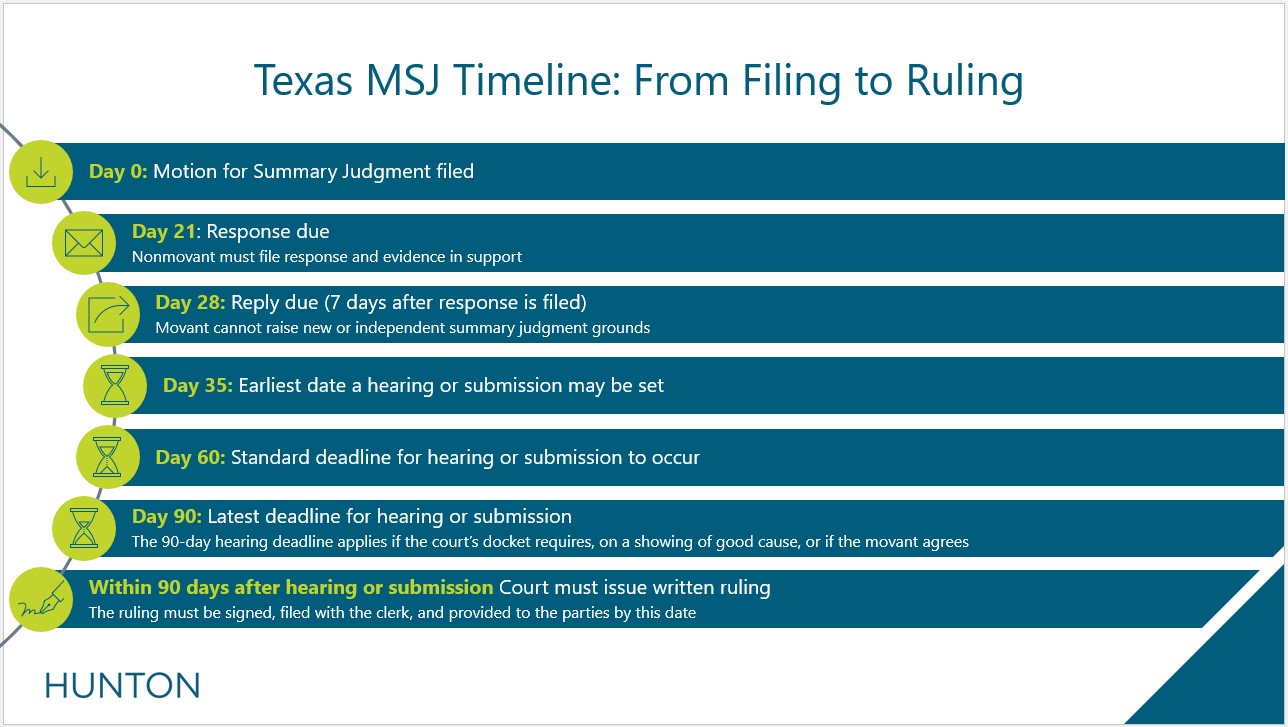
Briefing deadlines are now tied to the motion filing date—with the nonmovant’s response being due 21 days after the motion is filed, and the movant’s reply being due 7 days later. This is true regardless of whether a hearing has been set, marking a change from the prior version of Rule 166a, under which response deadlines were tied to the hearing date and there was no specific deadline for replies. The new default briefing deadlines may, however, be changed upon agreement of the parties or leave of court.
The amended rule also includes specific deadlines by which (i) summary judgment motions must be set for hearing or submission and (ii) courts must issue rulings. Similar to the structure of deadlines under other Texas Rules of Civil Procedure, (i) the hearing or submission date must not be earlier than 35 days after the motion is filed; (ii) the court must set the motion for hearing or submission within 60 days of its filing (or 90 days (1) if the court’s docket so requires, (2) on a showing of good cause, or (3) if the movant agrees); and (iii) the court must issue a ruling within 90 days after the hearing or submission date.
2. New Motion Formatting and Titling Rules
The amended rule also clarifies certain aspects of the formatting of summary judgment motions and adds critical definitions. The amended rule for the first time defines “traditional” and “no-evidence” motions for summary judgment and includes standards for granting each. Rule 166a now also expressly authorizes parties to file a single motion combining both traditional and no-evidence summary judgment grounds—a practice that was commonplace prior to the amendments but not expressly contemplated by the rule. In conjunction with these changes, Rule 166a now requires every motion for summary judgment to be titled one of the following: (i) Traditional Motion for Summary Judgment, (ii) No-Evidence Motion for Summary Judgment, or (iii) Combined Motion for Traditional and No-Evidence Summary Judgment.
In addition to the new titling requirement for movants, respondents must also consider titling when filing their response briefs. Amended Rule 166a now requires that any request for oral argument appear in the title of the response pleading.
3. Limits on Scope of Reply Briefs
Another change concerning replies is amended Rule 166a’s express limitation of the scope of replies in support of motions for summary judgment. Now, a movant cannot raise new or independent summary judgment grounds in its reply other than to address new or amended pleadings filed after the motion “if a ground initially asserted in the motion negates an element that is common to a claim or defense asserted in the new or amended pleading.”
4. Changes to Continuance Practice
With respect to continuances, amended Rule 166a sets out specific evidentiary requirements for supporting requests for continuance and details options for the court to exercise discretion in delaying rulings on motions for summary judgment. To that end, if a nonmovant requires additional time to obtain evidence prior to responding to a motion for summary judgment, the nonmovant must file a declaration or affidavit detailing the reasons why it cannot present essential facts necessary to support its opposition. The court may then (i) extend the time to file a response, (ii) deny the motion without prejudice to permit further discovery, or (iii) issue any other appropriate remedy.
5. Clarified Evidentiary Standards and Affidavit Treatment
Amended Rule 166a specifically enumerates the types of evidence that may accompany a traditional summary judgment motion, formalizing common categories historically presented by parties. Acceptable evidence now explicitly includes (i) deposition transcripts, (ii) the opposing party’s pleadings and discovery responses, (iii) affidavits and declarations, (iv) stipulations, and (v) other forms of authenticated evidence. Notably, the amended rule allows parties to “produce by reference” rather than attaching the evidence directly, so long as the filing clearly identifies where the referenced material can be found in the court’s record.
The amendments also address the handling of late-filed evidence. Courts are permitted to consider evidence submitted after the applicable deadlines if the record reflects the court’s decision to do so. However, the rule does not establish a procedure for how the court should make this acknowledgment on the record.
The amended Rule 166a also changes how affidavits are handled in summary judgment proceedings. Under the previous rule, when a court determined that an affidavit had been filed in bad faith or simply to cause delay, it was obligated to require the responsible party to pay the opposing party’s reasonable expenses, including attorneys’ fees. The new rule does away with this mandate—the court now has the discretion to impose such costs, provided the parties have received notice and a reasonable opportunity to respond. In addition, the revised rule clarifies that minor or technical defects in the form of an affidavit or declaration will not serve as grounds for reversal on appeal unless the opposing party raises a timely objection and the party offering the affidavit fails to correct the problem after being given the opportunity to do so.
6. Formal Withdrawal Requirement
Finally, amended Rule 166a provides that a party seeking to withdraw a motion for summary judgment must file a formal written withdrawal that states the filing date of the motion being withdrawn.
The recent amendments to Rule 166a bring much-needed clarity to Texas summary judgment practice. By introducing clear timelines, refining the rules surrounding motion format, evidence, replies, and continuances, and providing structure for withdrawing motions, the Supreme Court of Texas has taken significant steps toward making the summary judgment process more transparent and predictable. As practitioners adjust to the new framework, they will likely benefit from a more streamlined process that focuses attention on substantive legal arguments rather than procedural uncertainty.