What Happened:
The Committee on Foreign Investment in the United States (CFIUS or the Committee) recently released its annual report to Congress for calendar year 2025 (the Report). The Report is the first annual report to Congress that captures a full year under the Trump Administration’s America First Investment Policy (AFIP), and the first that is materially shaped by lapses in appropriations and the related tolled statutory deadlines in active cases.
The Bottom Line:
The 2025 data show a Committee that processed a modestly larger overall caseload than in 2024. The data also show a continuing move away from mitigation as its default risk-management tool. Key takeaways for foreign investors and others considering transactions within CFIUS’s purview:
- Overall caseload ticked up with an increase in the number of declarations filed. The Committee reviewed or assessed 347 covered transactions in 2025 (140 declarations and 207 notices), compared with 325 in 2024. Notices were near flat year-over-year (207 in 2025 versus 209 in 2024 and 233 in 2023), while declarations rose 21 percent to 140 declarations filed in 2025, the highest level since the 2021 peak of 164.
- Declaration clearance deteriorated. While the number of declaration filings increased, CFIUS cleared only 66 percent of declarations in 2025, down materially from 78 percent in 2024 and 76 percent in 2023. CFIUS requested a full notice filing in 26 percent of declaration cases, up sharply from 15 percent in 2024. The 2025 declaration numbers more closely resemble 2022, the year practitioners previously regarded as an aberration, than the two intervening years.
- Withdraw-and-refile activity increased. Of 207 notices filed in 2025, 61 (29 percent) were withdrawn, and 58 of those withdrawals came after commencement of an investigation (28 percent of all notices, up from 23 percent in 2024). Fifty-one withdrawn notices were refiled, 14 of them not until 2026. This comes as representatives of the Committee have expressed a desire to cut down on the number of cases withdrawn and refiled, consistent with AFIP goals. Seven withdrawals were not refiled.
- Mitigation continued to decline. CFIUS concluded action after entering into a mitigation agreement with respect to 15 notices, approximately 7 percent of 2025 notices, down from 9.6 percent of distinct notices in 2024, 21 percent in 2023, and 23 percent in 2022. The difference between 2022–23 and 2024–25 appears significant. Open mitigation agreements under monitoring fell slightly to 234 (from 242 in 2024 and 246 in 2023), and site visits dropped by roughly half, to 40 from 79. This is consistent with AFIP goals of reducing the Committee’s reliance on mitigation to clear transactions.
- Two presidential prohibition orders were issued. Presidential decisions were issued with respect to two transactions notified to CFIUS in 2025, each prohibiting the purchase and requiring divestment. The Committee also adopted a mitigation agreement following a de novo review of a 2024 transaction that was prohibited by presidential order in 2025.
- Critical technology filings rose. CFIUS reviewed 166 covered transactions involving acquisitions of US critical technology companies in 2025, up from 150 in 2024 and 153 in 2023, and the manufacturing sector’s share of notices grew to 40 percent.
- Appropriations lapses were the dominant procedural story. Three separate lapses tolled statutory deadlines. Net of tolled days, CFIUS cleared 67 percent of all covered transactions within the 30-day assessment period or the initial 45-day review period.
- New process initiatives are underway. Treasury launched the Known Investor Pilot Program to implement AFIP’s “fast track” direction, signed a Memorandum of Understanding with the US Department of Agriculture (USDA), and established a new Office of Research and Analysis within the Office of Investment Security (OIS).
We discuss these highlights further below.
The Full Story:
Declarations: Volume Rebounds, But Clearance Rates Fall
CFIUS assessed 140 declarations of covered transactions in 2025, up from 116 in 2024 and 109 in 2023, and the second-highest annual figure on record. Seven of the 140 were covered real estate declarations filed under 31 C.F.R. part 802. Parties stipulated that 51 declarations, or 36 percent, were subject to a mandatory filing requirement, up from 33 percent of declarations stipulated as mandatory in 2023.
As the volume of declarations increased, outcomes deteriorated—possibly signaling the use of the declaration filing process where a notice filing would have been more appropriate. CFIUS concluded action with respect to 92 declarations (66 percent) in 2025, a drop from the 78 percent clearance rate in 2024 and the 76 percent rate in 2023. The Committee requested that declaration parties file a notice in 36 cases (26 percent), a jump above the 15 percent recorded in 2024 and the 18 percent recorded in 2023. CFIUS informed parties it was unable to conclude action (i.e., “shrugged”) in 11 cases (8 percent). No declarations were rejected and one was withdrawn in 2025.
The declaration numbers for 2025 are notable because the 2023 and 2024 data had been read by practitioners as evidence of increasing sophistication among filers able to decide between a declaration and notice filing, and growing comfort on the part of CFIUS with the declaration format. The 2025 numbers suggest either that filers are testing the declaration process with a broader range of transactions, including those that were more appropriate for a notice filing, or that the Committee is applying a higher bar to concluding action on the abbreviated declaration format. The data shifts the expected value of a declaration. The most recent numbers show that roughly one in three declarations does not resolve the transaction, and one in four ends with the parties preparing a full notice after having already spent 30 days in assessment. Transaction parties should consider carefully the choice between a declaration and notice filing.
On timing, the average number of calendar days between submission of a declaration and Committee acceptance was 6.87 days, and the Committee took an average of 30.1 calendar days (median 30.0) to act on declarations, net of days tolled by the lapse in appropriations. The Committee granted no waivers of the mandatory declaration requirement under Section 721(b)(1)(C)(v)(IV)(bb)(CC) in 2025.
Notices: Steady Volume, More Withdrawals, Longer Investigations
CFIUS accepted 207 written notices of covered transactions in 2025, a marginal decrease from the 209 notices filed in 2024 and well below the 286 notices filed at the 2022 peak. Seven were real estate notices under part 802. The Committee initiated a subsequent investigation with respect to 114 notices (55 percent), consistent with the 56 percent recorded in each of 2023 and 2024, and 8 notices were subject to the 15-day extraordinary-circumstances extension available under Section 721(b)(2)(C)(ii)(I).
As notice volume held steady, withdrawals rose. In 2025, 61 notices (29 percent of notices) were withdrawn, of which 58 were withdrawn after commencement of the investigation period. That 28 percent post-investigation withdrawal rate is the highest since 2022 and up from 23 percent in 2024. Parties refiled withdrawn notices in 51 instances. Ten transactions were abandoned: seven after CFIUS advised that it could not identify adequate mitigation or proposed mitigation the parties declined to accept, and three for commercial reasons. CFIUS rejected three notices in 2025, up from one in 2024.
Because the Report does not identify unique filings, the headline numbers overstate distinct deal activity. Adjusting the 347 total filings for the 36 declarations that resulted in a request for a notice and the 37 notices refiled within 2025 yields something on the order of 274 distinct transactions, broadly in line with the 269 distinct transactions reported for 2024 and still materially below the 326 distinct transactions in 2022. After three consecutive years of decline, the downward trend in CFIUS deal flow appears to have flattened.
Committee Timelines and the Appropriations Lapses
The largest procedural development of 2025 was outside the Committee’s control. A lapse in appropriations for all US Government agencies ran from October 1 to November 12, 2025; a second lapse affecting Treasury and several other CFIUS member agencies ran from January 31 to February 3, 2026; and a third, affecting components of the Department of Homeland Security, ran from February 14 to April 30, 2026. Pursuant to Section 721(b)(8), statutory case deadlines tolled during each lapse, and the Committee’s ability to accept new transactions was delayed. Parties filing with CFIUS during a lapse were notified of the tolling and that acceptance of filings would be delayed in many cases. Assistant Secretary for Investment Security Chris Pilkerton acknowledged in his transmittal message that the disruption to the CFIUS review process created uncertainty for investors and the business communities that depend on a predictable review process. The impacts on regulatory clearance to deal timelines are likely to affect the negotiation of clearance conditions between transaction parties for some time.
Net of tolled days, the reported timelines were otherwise stable or improved. The Committee provided written comments on draft notices in an average of 5.35 business days, down from 6.5 days in 2024 and 8 days in 2023, and accepted formal written notices in an average of 3.44 business days, up modestly from 2.7 days in 2024. Both figures remain comfortably inside the 10-business-day statutory benchmark. Transactions closing in review averaged 45.4 calendar days (median 45.0) and transactions closing in investigation averaged 82.8 calendar days (median 91.0). Critically, the reported averages exclude tolled days, and the impact of tolled statutory deadlines in 2026 on parties with cases pending or initiated in late 2025 is not fully captured in the 2025 reporting period.
Geographic and Sectoral Distribution: Japan Consolidates, China’s Numbers Remain Inflated
Investors from China accounted for the most notices in 2025 with 33 filings (17 percent), followed by Japan with 23 (12 percent), the United Arab Emirates with 18 and Canada with 15. Germany (14), Israel (12), France (10), and Singapore (10) round out the leading filers. The Report notes that on a distinct-transaction basis, counting only once those transactions that originated as declarations and were later filed as notices, or that were withdrawn and refiled, the highest number of notices in 2025 came from investors from Japan, the United Arab Emirates, and Canada rather than China. This confirms what practitioners have long observed and what the 2024 Report suggested: Chinese filers withdraw and refile at materially higher rates than filers from other jurisdictions, and headline Chinese notice counts should be discounted accordingly to avoid double counting.
On the declaration side, investors from Japan led with 18 declarations, followed by France (14), Singapore (13), Germany (12), South Korea (11), and the United Kingdom (11). Chinese investors filed five declarations in 2025, continuing a trend of concentrating most filings in the notice process. For the three-year period from 2023 through 2025, investors from Japan accounted for the largest proportion of declarations (12 percent, or 45 filings), followed by France (8.9 percent), and Canada (8.7 percent). Over the same three-year period, investors from China led notice filings with 92 (14 percent), followed by Japan (62) and the United Arab Emirates (61).
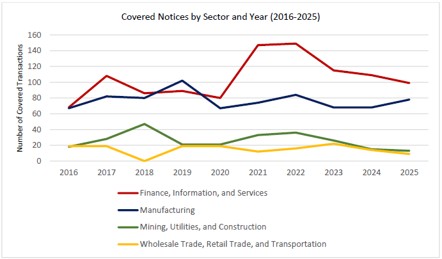
The sectoral data show a meaningful shift. Of the 200 non-real estate notices, the Finance, Information, and Services sector accounted for 99 (50 percent), down from 53 percent in 2024 (likely reflecting the growing interest in artificial intelligence), while Manufacturing rose to 79 notices (40 percent), up from 33 percent in 2024 and its highest share since 2019. Mining, Utilities, and Construction fell to 13 notices (7 percent) and Wholesale Trade, Retail Trade, and Transportation to 9 (5 percent).
Within Manufacturing, Computer and Electronic Product Manufacturing was the largest subsector with 33 notices (42 percent of the sector), driven by a substantial increase in Semiconductor and Other Electronic Component Manufacturing, which went from 4 notices in 2024 to 17 in 2025. Transportation Equipment Manufacturing followed with 17 notices, with Aerospace Product and Parts Manufacturing more than doubling to 13 notices. Within Finance, Information, and Services, Professional, Scientific, and Technical Services remained the largest subsector with 42 notices, led by Computer Systems Design and Related Services (20 notices), and Scientific Research and Development Services (12). Utilities filings continued their multi-year decline, falling to 7 notices from 11 in 2024 and 20 in 2023.
Critical Technologies Filings Increase
CFIUS reviewed 166 covered transactions involving acquisitions of critical technology TID US businesses in 2025, up from 150 in 2024 and 153 in 2023. Because total notice filings were essentially flat year-over-year, the data show that critical technology transactions represented a growing share of the Committee’s docket in 2025. Top acquirer home countries for critical technology transactions were Japan (20), France (16), Israel (15), Germany (13), and the United Kingdom (10); China accounted for 8. The Professional, Scientific, and Technical Services sector produced the largest number of critical technology cases (39), followed closely by Computer and Electronic Product Manufacturing (38).
The concentration of critical technology filings among close allies and partners is a durable feature of CFIUS’s reported data and reinforces practitioner views that sector and technology, rather than acquirer nationality or transaction size, drive the mandatory filing analysis.
Mitigation Continues to Decline
Mitigation activity fell for the second consecutive year. CFIUS adopted mitigation measures or conditions with respect to 25 notices filed in 2025, approximately 12 percent of notices, but concluded action after entering into a mitigation agreement with respect to only 15 notices, roughly 7 percent of 2025 notices. That compares with 9.6 percent in 2024, 21 percent in 2023 and 23 percent in 2022. Seven agencies served as US Government signatories to those agreements.
Separately, CFIUS entered into mitigation agreements to address residual national security concerns with respect to two transactions that filing parties voluntarily withdrew and abandoned; imposed conditions in withdrawal-and-abandonment letters for five additional notices; and imposed interim mitigation with respect to two notices while its review was pending. The Committee also adopted one mitigation agreement following a de novo review of a covered transaction filed in 2024 and prohibited by presidential order in 2025.
The two-year decline is consistent with AFIP’s direction that CFIUS move away from open-ended mitigation agreements in favor of concrete actions companies can complete within a specified period. The 2025 numbers suggest, however, that the shift is not simply a substitution of shorter agreements for longer ones. Presidential decisions were issued with respect to two 2025 notices, in each case prohibiting the purchase and requiring divestment. These were the first presidential orders arising from newly filed transactions since 2020, following two in 2024. Taken with the seven transactions abandoned after CFIUS declined to identify acceptable mitigation, the data indicate a Committee more willing to reject a transaction outright, and correspondingly less willing to paper over residual risk. Filing parties should consider that a transaction presenting identifiable national security risk may not be cleared through a national security agreement on terms that were achievable in 2022 or 2023.
Monitoring and Enforcement: Fewer Site Visits, No Reported Penalties
As of the end of 2025, the Committee was monitoring 234 mitigation agreements and conditions, down from 242 at the end of 2024 and 246 at the end of 2023. Four agreements were materially modified in 2025 and 23 were terminated. All active mitigation agreements that became effective in 2025 have compliance plans that entail ongoing compliance obligations and monitoring.
CFIUS monitoring agencies reported conducting 40 site visits in 2025, a decrease from the 79 conducted in 2024 and below the 43 conducted in 2023. The Report describes those visits as involving compliance-focused interviews with senior executives and line-level personnel, inspection of records and systems, and verification of physical and logical access controls. The Committee issued two formal determinations of noncompliance with the mandatory filing requirements under 31 C.F.R. § 800.401 and continued to receive and act on voluntary self-disclosures relating to other potential failures to file.
The Report does not disclose any civil monetary penalties assessed in 2025. That is a departure from the last two reporting cycles, which disclosed four penalties in 2023 and five in 2024, including the $60 million penalty for material misstatements in a notice filing that remains CFIUS’s largest to date. CFIUS has not announced any change from its recent focus on enforcement and the Report emphasizes that many instances of noncompliance do not result in a penalty. Whether the absence of reported penalties reflects improved compliance, a reduced monitoring footprint, or a change in enforcement posture remains to be seen, and companies subject to national security agreements should not read the 2025 data as a relaxation of compliance expectations. The establishment of a dedicated Office of Compliance and Enforcement within OIS points in the opposite direction.
Non-Notified Transactions: A Narrower Funnel
CFIUS again reported identifying thousands of potential non-notified and non-declared transactions in 2025, drawn from interagency referrals, public tips, classified reporting, media reports, self-disclosures, congressional notifications, and commercial databases. The Committee investigated 90 of these non-notified/declared transactions to determine which to open as official inquiries. CFIUS opened official inquiries into 62 transactions and requested a filing for 9 of them, approximately 15 percent of inquiries, compared with 16 percent in 2024 and 22 percent in 2023. In two instances, parties in receipt of non-notified outreach voluntarily filed a declaration or notice before receiving a formal request.
The absolute numbers are down across the board from 2024 (76 official inquiries and 12 requested filings), which may reflect the staffing constraints described elsewhere in the Report as much as a change in approach. The Report continues to characterize the Committee’s approach as targeted and describes non-notified matters as among the most complex CFIUS considers. Companies that closed transactions without a filing, particularly in the semiconductor, aerospace, life sciences, and artificial intelligence subsectors, should continue to assume that non-notified outreach remains a live possibility years after closing.
Real Estate Transaction Filings Remain Rare
Filers submitted seven declarations and seven notices for covered real estate transactions in 2025, compared with six declarations and three notices in 2024, and three declarations and two notices in 2023. Although 2025 represents the highest real estate volume recorded to date, the numbers remain a small share of CFIUS’s caseload and fall far short of the Committee’s 2020 projections for real estate filings under the then-proposed rules to implement the Foreign Investment Risk Review Modernization Act (FIRRMA)—when CFIUS anticipated an annual caseload of 150 real estate notices and 200 real estate declarations per year. 2025 is the first full reporting year following the November 1, 2024, expansion of sensitive military installations and enlarged the radius around air and maritime ports subject to CFIUS review. The modest uptick suggests that the expansion may have had some impact, but perhaps less than many practitioners anticipated. With state-level restrictions on foreign ownership of real estate proliferating and continued legislative attention to agricultural land, it is reasonable to anticipate that real estate filings will remain an area to watch in subsequent reporting cycles.
Important Developments
The Report and the accompanying transmittal message highlight several developments relevant to foreign investors and others considering a transaction subject to CFIUS’s authority to review:
- Known Investor Pilot Program. Treasury launched the Known Investor Pilot Program in 2025 to implement AFIP’s direction to create an expedited “fast track” process facilitating greater investment from allies and partners. The program seeks to collect detailed information from foreign investors in advance of filing so that CFIUS can realize administrative efficiencies. Investors with a repeat US investment program should evaluate participation, as front-loaded diligence may translate into materially shorter timelines on subsequent transactions.
- USDA Memorandum of Understanding. On July 8, 2025, Secretary Bessent and Secretary Rollins signed a Memorandum of Understanding memorializing USDA’s role as a CFIUS member for transactions involving agricultural land, agricultural biotechnology, or the agriculture industry, and committing to improved information sharing on foreign investment in agricultural land. This formalizes a requirement introduced by section 787 of the Consolidated Appropriations Act of 2024 and aligns with continued focus on agricultural land as having national security implications.
- Office of Research and Analysis. In 2025, OIS established an in-house technical branch composed of scientists, engineers, and data subject matter experts dedicated to investigating and reviewing foreign investments. This may be in response to increasing focus on critical technologies. Parties should expect increasingly technical questions in requests for information, particularly in critical technology matters.
- International engagement. OIS, working with the State Department and the Office of the US Trade Representative, secured investment security commitments in reciprocal trade and investment agreements with certain countries for the first time, an incremental but meaningful step toward harmonized allied screening. At a CFIUS conference earlier this year, representatives acknowledged working closely with Japanese counterparts on an investment screening regime.
*****
The national security, mergers and acquisitions, private equity, and competition practices at Hunton Andrews Kurth LLP will continue to monitor the developments of CFIUS and cross-border investment matters. Please contact us if you have any questions or would like further information regarding CFIUS or require our assistance in considering what CFIUS’s 2025 Annual Report may mean for your transaction.