International oil and gas projects are built on long-term relationships between multiple joint venture parties. Ideally all parties are aligned throughout the project on all aspects of the petroleum operations and the related work programmes and budgets. In reality, this is not always achievable. Petroleum prices fluctuate, government’s priorities can change, corporate strategies and risk appetites diverge over time, and disagreements and deadlocks can arise. While many contracts for petroleum projects contain dispute and deadlock resolution mechanisms, including expert determination clauses and buy-out provisions, parties sometimes seek to use “exclusive operations” clauses as a way to deal with disagreements within the joint venture.
This article considers two types of “exclusive operations” provisions from the perspective of the host state and/or the national oil company (NOC) in the context of a petroleum project governed by a production sharing contract (PSC). These are:
- The exclusive operations provisions typically included in the joint operating agreement (JOA) governing the joint venture relationship of the contractor parties under a PSC (the Contractor).
- Provisions in a PSC which allow the host state/NOC to undertake petroleum operations without the participation of the Contractor group in certain specified circumstances.
JOA Exclusive Operations
JOAs usually contain a provision which allows for certain types of petroleum operation to be conducted by fewer than all the parties to the JOA (referred to in this article as “Exclusive Operations” and often referred to as sole risk). In general, a petroleum operation can be proposed as an Exclusive Operation where (i) a proposal for a petroleum operation has been put to the JOA operating committee and has not been approved by the requisite majority[1]; and (ii) the petroleum operation is one that can be conducted as an Exclusive Operation under the terms of the JOA. The chart below broadly illustrates the Exclusive Operations process set out in Article 7 of the AIEN Model JOA 2023:
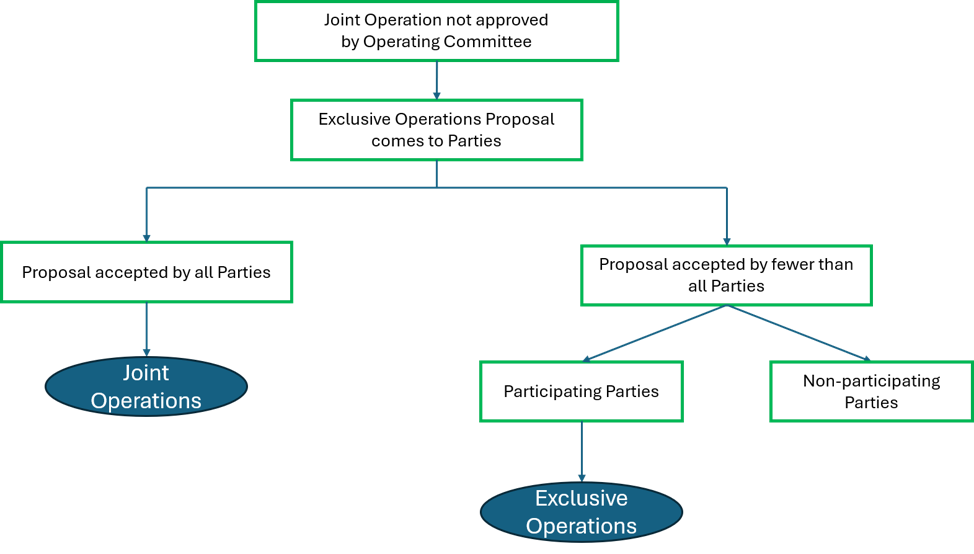
- A petroleum operation is rejected by the JOA operating committee.
- A party that supported the rejected proposal may submit an Exclusive Operation proposal (for the same petroleum operation) to all parties.
- If approved by all parties, it proceeds as a joint operation.
- If approval is not unanimous, the dissenting party or parties may choose not to participate in the proposed petroleum operation.
- The proposing party, together with any consenting parties, may undertake the operation at their own cost and risk as an Exclusive Operation.
- The Exclusive Operation participants indemnify the non-participating parties against liabilities arising out of the exclusive operation.
- The non-participating parties usually retain back-in rights, allowing them to rejoin later by paying a premium of, typically, 200% to 1,000% of the costs incurred by the participating parties in conducting the Exclusive Operation.
As mentioned above, not all operations can be undertaken as Exclusive Operations. For example, JOAs will most likely provide that the Contractor’s minimum work obligations under the PSC must be performed as a joint operation by all participants. Exclusive Operations provisions should define clearly, and narrowly which operations may be proposed and conducted as exclusive operations.
Common examples of Exclusive Operations include:
- drilling an appraisal well or an exploration well;
- deepening or sidetracking an existing well; and
- extended well testing.
JOA Exclusive Operations: issues for governments and NOCs
Exclusive Operations may have a number of implications for host states and/or the NOC and some examples of these are set out below.
Relationship Between the PSC and JOA
The PSC will always take precedence in governing the relationship between the host state/NOC and the Contractor parties including over any terms of the JOA. Therefore, if the host state wishes to discourage or control Contractor-side Exclusive Operations, it may do so through restrictions, conditions or approval requirements in the PSC. However, in practice express prohibitions on Exclusive Operations are uncommon.
Whilst express prohibitions may not be common, Exclusive Operations may well be constrained by other elements of the terms of the PSC such as, the governance provisions in relation to the approval of operations and budgets for PSC related work, the use of a single designated operator, cost-recovery rules tied to approved joint operations, and restrictions on transfers or changes in participating interests.
Generally, the JOA will include a detailed mechanism to handle Exclusive Operations with caveats to try to ensure that the related PSC is complied with. However, where the NOC is not a party to the JOA, there will likely be an assumption that the Exclusive Operations provisions are a private matter between the Contractor parties, as long as they don’t conflict with the PSC. Whether Exclusive Operations can be implemented consistently with the PSC is a question of contractual interpretation. It is important that both the host state/NOC and the Contractor parties consider such issues when the PSC and the JOA are being agreed and entered into.
Potential for Increased Complexity and Uncertainty
Exclusive Operations by less than all the Contractor parties can introduce additional complexity into the relationship between those parties and this in turn can impact the interests of the host state/NOC. For example:
- the PSC will set out the basis on which the Contractor parties are responsible for PSC obligations and associated liabilities. This may be on a joint and several basis or in accordance with the participating interests of each Contractor party. An Exclusive Operation, will seek to adjust the responsibilities and entitlements of the Contractor parties in respect of the relevant operation in a way that may not be aligned with the PSC. A Contractor party that is not participating in the Exclusive Operation may remain liable vis-à-vis the host state/NOC notwithstanding the internal allocation agreed under the JOA.
- The more complex allocation of obligations and entitlements amongst the Contractor parties can lead to misalignment and potential disputes between them.
- The Contractor group may put forward cost recovery claims based on internal arrangements the host state/NOC did not approve. This may lead to questions as to whether such costs should be recoverable at all.
- There could be potential uncertainty as to who bears abandonment, HSE, and local-content obligations and costs for the Exclusive Operation.
Exclusive Operations–A Transfer of a PSC Interest?
Exclusive Operations involve a reallocation of economic interests between the Contractor parties for the relevant operation. While such reallocation does not usually involve a legal transfer of a working interest, it may arguably have the same effect and can be characterised in substance as a transfer or other disposition of a partial interest in the PSC requiring government approval. This is because it could, for example, alter production entitlements (to cost oil/gas and profit oil/gas) amongst the Contractor parties. Depending on the drafting of the PSC and applicable law, restrictions on assignments, transfers, or other dealings in participating interests in the PSC may be triggered.
Impact on the NOC
A NOC’s perspective on Exclusive Operations will depend on its role in the petroleum industry of the relevant jurisdiction, and its position in the specific project. Does the NOC act as the formal counterparty to the PSC on behalf of the host state? Is it part of the Contractor group, is it party to the JOA? Is it carried during exploration? Is it a fully paying participant? Is it the operator? Does it own transportation, processing, storage or export infrastructure? The answers to those questions will shape how the NOC would assess the risks and advantages of sole risk operations.
When an NOC is part of the Contractor group, the Exclusive Operations provisions (if allowed under the PSC) should be carefully reviewed from the NOC’s perspective to consider the potential economic impact of such operations, including any effect on its entitlement to be carried, to receive profit petroleum, its current or future cost exposure, and the timing and sequencing of the Exclusive Operation and its milestones.
Operatorship of Exclusive Operations
Exclusive Operations give rise to the issue of which party is going to conduct the operations. It could be that the nominated operator under the JOA is a non-participating party in the Exclusive Operation and the JOA may provide that another Contractor party will take over conduct of the Exclusive Operation. This could conflict with the PSC as a Contractor party is often designated as operator under the PSC and may be therefore required to continue acting as operator of the Exclusive Operation whether or not it has consented to the relevant operation. That raises practical and liability issues, particularly where the operator is subject to a no-profit, no-loss standard and does not wish to devote resources to a project it has declined to support economically.
Costs of Failed Exclusive Operations
From the host state perspective, if an Exclusive Operation is unsuccessful, and consequently there are no revenues against which the Exclusive Operation participants can recover their costs, those costs should not be recoverable from revenues attributable to joint operations or otherwise allocated to non-participating parties. If the PSC and/or JOA are silent on this point, it may open the door to competing interpretations.
During the term of a PSC, host states/NOCs will generally have a broader set of objectives than the companies comprising the Contractor, including a focus on issues such as the efficient development of the country’s natural resources, long-term energy security, domestic supply requirements, reserve replacement, the development of national capabilities, and other matters of public-interest. If the issue is raised, the Contractor parties to a PSC will likely try to assert that an Exclusive Operations mechanism in the JOA is beneficial because it provides a route through investor deadlock and will result in more operations being conducted. However, such mechanisms should be considered carefully from the host state and NOC perspective (ideally on entry into the relevant contracts) as Exclusive Operations do not just impact the Contractor parties.
Can Host States or NOCs Conduct “Sole Risk” Operations?
In some cases, exclusive operations or sole risk provisions also appear in PSCs themselves. Where this is the case, the relevant clauses may grant the host state or the NOC the right to conduct petroleum operations on a sole risk basis to the exclusion of some or all of the Contractor parties.
These provisions may become relevant in a situation where there is a deadlock between the host state and Contractor parties in relation to a particular operation or a development plan, or where the Contractor is seen as stalling the project and delaying investment. Depending on the way this type of sole risk is structured and drafted in the PSC, the outcome may be different from Contractor-side Exclusive Operations. Where some Contractor parties proceed with an Exclusive Operation, any enhanced entitlement comes from the Contractor’s share of production. Where the state or NOC proceeds with an operation rejected by the Contractor, the consequences can be quite different. The Contractor may be excluded temporarily or permanently from the production stream. In some structures, the Contractor’s entitlement may be reduced, suspended, or excluded for a period altogether.
The host state or NOC may be tempted to rely on sole risk provisions in the PSC in order to break a deadlock, expedite development, ensure that its proposed plan is approved, or otherwise put pressure on the Contractor to move forward. Doing so can be risky unless the terms of the PSC clearly and unequivocally allow the Government or NOC to proceed on a sole risk basis in the existing circumstances and in respect of the specific petroleum operations being proposed. The sole risk route may appear to offer an opportunity to take back control over a stagnant project, but it may also prove contentious as the Contractor parties may view it as a hostile move and consider their remedies under the PSC and potentially even applicable investment treaties. If sole risk is drafted appropriately and exercised strictly in accordance with the contract, arguably there should be no basis for any type of direct expropriation claims, particularly where the Contractor would be given an opportunity to reinstate its rights in the future by exercising its back-in rights upon payment of the applicable premium. Yet the terms of the PSC and JOA should be considered carefully and comprehensively before any such decision is made.
We have seen examples of PSCs where the host state/NOC has reserved rights to conduct sole risk operations but on terms which are not clear as to when such rights are exercisable. If a host state/NOC purports to exercise rights on terms which are not clear, then this can (and has) led to formal disputes between the host state/NOC and the Contractor parties over the interpretation of the relevant provision. Such disputes inevitably cause delay and result in additional costs for both parties and ultimately may result in one or more of the Contractor parties exiting the project.
When exercised thoughtfully and within clearly drafted limits, sole risk can provide a practical mechanism for advancing petroleum operations where joint venture alignment cannot be maintained on a particular issue. However, for host states, NOCs and IOCs alike, its effectiveness depends on clear drafting, careful implementation and close attention to the wider contractual and relationship context. Poor drafting or aggressive use can create commercial and dispute risk for all parties.
[1] We have not considered the situation where the JOA contains a non-consent right where parties to the JOA can opt out of some petroleum operations which have been approved by the requisite majority at the operating committee.