
Last month, the solar eclipse captivated the United States and many consumers flocked to purchase solar eclipse glasses to safely observe the astronomical phenomenon. We previously reported how NASA issued a safety alert advising consumers on the proper eye protection they should seek. Now, some consumers have filed a class action lawsuit against a major online retailer for allegedly selling “unfit, extremely dangerous, and/or defective” solar eclipse glasses. As a result, the consumers allege “varying degrees of eye injury ranging from temporary discomfort to permanent blindness.”
CBS News recently reported that a major used car dealer is selling vehicles with unrepaired defects subject to safety recalls. Notably, the National Highway Traffic Safety Administration regulates vehicles and not the CPSC. Still, this news serves as a reminder to the secondary market for all consumer products that selling recalled products opens the door to products liability litigation and may facilitate a multimillion dollar civil penalty from the CPSC. In fact, the CPSC has issued guidance to help resellers navigate this tricky landscape.
Next month, the CPSC’s political balance will shift in a way that could reshuffle the agency’s enforcement focus. In February, we reported that the CPSC had a new Acting Chairman, although the agency still had three Democratic and two Republican commissioners. That political balance will change soon as the term of Commissioner Robinson—a Democrat—expires next month. President Trump recently announced his intent to nominate Dana Baiocco to fill that commissioner vacancy for a seven-year term. Baiocco is a Boston-based law partner whose experience includes helping companies navigate product recalls and defending companies accused of selling unsafe products. If successful, Baiocoo’s arrival at the CPSC will create a Republican majority for the first time in years.
September also offered an important update regarding pool safety. Drowning is the leading cause of unintentional death among children ages one through four and is the second leading cause among children ages five through 14. The CPSC has worked to combat this problem through a public education campaign and a recent study revealed some positive results. However, the CPSC released its latest pool safety statistics this month and the results were still grim. From Memorial Day through Labor Day 2017, at least 163 children younger than the age of 15 fatally drowned in swimming pools or spas. Nearly 70 percent of the victims were children younger than the age of five. While these statistics are lower than they were a few years ago, they demonstrate that there is plenty of room for improvement with respect to pool safety.
Lawyers from Hunton & Williams LLP’s Insurance Coverage practice group weigh in regarding recent insurance coverage cases involving product recall claims:
Product recall insurance litigation was slow in the month of September, with the exception of an interesting lawsuit filed in Northern Illinois. The suit was filed by an Alaska union-benefits fund against Abbott Laboratories, alleging that one of Abbott’s medical device companies failed to warn the public and regulators about defective lithium batteries in implantable defibrillators. The union seeks to act as class-representative for all self-insured and commercial insurance companies impacted by hundreds of millions of dollars in pay-outs associated with the battery recall. Class actions involving insurance claims are not new; earlier this year, Allstate sued a manufacturer, seeking to recover the $3.6 million in payouts associated with 44 clothes dryer fires. Suits like these should remind product manufacturers about the breadth of potential exposure associated with costly product recalls, and the importance of prompt response to indicia of product defects or safety concerns.
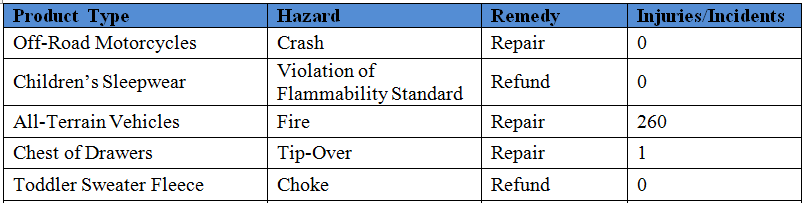
Total Recalls: 19
Hazards:
Fire/Burn/Shock (5); Crash (3); Injury (3); Fall (2); Tip-Over (2); Choke (2); Violation of Flammability Standards (1); Laceration (1)
Click on the below chart for additional information.
 Partner
Syed represents clients in connection with insurance coverage, reinsurance matters and other business litigation. Syed serves as the head of the firm’s insurance coverage practice. He has been admitted to the US Court of Appeals ...
 Partner
Kelly practices as a commercial and regulatory litigator on products liability and post M&A disputes and issues and serves as one of the firm’s Deputy General Counsel focusing on law firm ethics, conflicts, and risk management ...
Search
Recent Posts
Categories
- Advertising & Marketing
- Bankruptcy
- Class Action
- Competition/Antitrust
- Consumer Protection
- Corporate Governance
- Environmental
- General
- Health Care
- Insurance
- IP
- Labor and Employment
- Mergers & Acquisitions
- News & Events
- Patent Infringement
- Patents
- Privacy & Cybersecurity
- Product Liability
- Real Estate
- Regulatory
- Technology & E-Commerce
Tags
- 29 C.F.R. § 785.48
- 396-r
- 3D Printer
- 3D Printing
- A. Todd Brown
- A.S. Research (ASR)
- Aaron P. Simpson
- Accountability
- Administrative Agencies
- Administrative Exemption
- Advertisers
- Advertising
- Advertising Claims
- Advertising Guidelines
- Advertising Idea
- Agency Guidance
- Agency Principles
- AI Interviewing Platforms
- AI Technology Reviews
- AIA
- Air
- Algorithmic Accountability Act
- Align
- Americans with Disabilities Act
- Americans with Disabilities Act (ADA)
- Andrea DeField
- Ann Marie Buerkle
- Annual Reports
- anti-aging
- Anti-Competitive Marketplace
- Anti-Discrimination
- APEX Agreement
- Arbitration
- Arbitration Agreements
- Arizona
- Arkansas
- Arthritis
- Artificial Intelligence (AI)
- Asbestos
- Assembly Bill 51 (AB 51)
- ATDS
- Athlete Eligibility
- Australia
- Auto-renewals
- Automatic Telephone Dialing System (ATDS)
- Automobile
- Automotive Body Parts Association (ABPA)
- Back to Work Emergency Ordinance
- biased endorsements
- Biden Administration
- Biometric Data
- Biometric Information
- Biometric Information Privacy Act (BIPA)
- BIPA
- Bitcoin
- Blockchain
- Board Diversity Disclosure
- Boards of Directors
- Bonuses
- Braille
- Branding
- Breach
- Breach of Contract
- Business Interruption
- Business Interruption Loss
- Businessowner’s Insurance
- Buy Now, Pay Later
- California
- California Air Resources Board
- California Assembly Bill 2011
- California Employment Laws
- California Fair Employment and Housing Act
- California False Claims Act
- California Labor Code
- California Legislation
- California Privacy Protection Agency
- California Senate Bill 6
- California’s Unfair Competition Law
- CalRecycle
- CAMS
- Canada
- Cannabis
- CARB
- CBD
- CBP
- CCPA
- Celebrity Endorsers
- Center for Disease Control (CDC)
- CFIUS
- CGL
- Chatbot
- Children's Privacy
- Children’s Advertising
- Children’s Advertising Review Unit
- Children’s Online Privacy Protection Act (COPPA)
- China
- Christopher J. Dufek
- Christopher W. Hasbrouck
- Christy Kiely
- CIPA
- Class Action
- Class Action Litigation
- Class Actions
- Clawback
- Click-to-Cancel
- Climate Change
- Climate Disclosure
- clinical trials
- Collective Action
- Colorado
- Commerce Clause
- Commercial General Liability
- Commercial Leasing
- Commercial Messaging
- Commercial Products
- Commercial Real Estate
- Commodity Futures Trading Commission
- Compensation
- Compliance
- Confidentiality
- Congress
- Connecticut
- Consent
- Consent Order
- Consumer Advertising
- Consumer Data
- Consumer Financial Protection Bureau
- Consumer Fraud
- consumer loyalty program
- Consumer Privacy
- Consumer Product Safety Act
- Consumer Products
- Consumer Products Safety Commission (CPSC)
- Consumer Protection
- Consumer Review Fairness Act of 2016 (CRFA)
- Consumer Reviews
- Consumer Rights
- Contamination
- Contract Law
- Controlled Substance Act
- Cookies
- Cookware
- Copyright
- Coronavirus/COVID-19
- Corp Fin
- Corporate Governance
- Corporate Reporting
- Corporate Sustainability
- Corporate Transparency Act (CTA)
- Costco
- Counterfeit Goods
- Counterfeit Goods Seizure Act of 2019
- Court of International Trade
- CPRA
- CPSA
- CPSC
- Crack House Statute
- CRFA
- Crypto
- Cryptocurrency
- CSPA
- Cuba
- Currency
- Customs and Border Protection
- Cyber
- Cyber Coverage
- D. Andrew Quigley
- D&O
- D&O policies
- Damages
- Data Breach
- Davidson
- Deceptive Advertising
- DEI
- Delaware
- Delivery Drivers
- DEP
- Department of Agriculture
- Department of Justice
- Department of Labor
- Department of Transportation
- Development Impact Fee
- Dietary Guidelines
- Digital Assets
- digital currency
- Disclosures
- Discrimination
- Distribution
- District of Columbia
- Division of Corporation Finance
- Dodd-Frank
- DOJ
- DOL
- Duty to Defend
- Duty to Indemnify
- e-liquid products
- Eddie Bauer
- EEOC
- Electric Vehicles
- Eleventh Circuit
- Emily Burkhardt Vicente
- Employee Rights
- Employment-Based Immigration
- Endorsement
- Endorsement Guides
- Endorsement Notice
- Endorsements
- endorser monitoring requirements
- Enforcement
- Environmental Impact
- Environmental Protection Agency
- Environmental Protection Agency (EPA)
- EPA
- Epidemic
- ESG
- ESG Disclosure
- EU Regulation
- European Union
- European Unitary Patent
- EV Charging
- Exceptions
- Exclusions
- Executive Compensation Disclosure Rules
- Executive Order (EO)
- Executive Orders
- Exercise Machines
- Extended Producer Responsibility (EPR)
- FAA
- Fair Labor Standards Act
- Fair Labor Standards Act (FLSA)
- fair use
- False Advertising
- False Advertising Claims
- False Advertising Law
- False Claims Act
- Family Leave Policies
- FAR
- Fashion Accountability Acts
- FCC
- FCRA
- FDA
- Federal Acquisition Regulations
- Federal Arbitration Act (FAA)
- Federal Communications Commission
- Federal Contractors
- Federal Contracts
- Federal District Court
- Federal Government Contractor
- Federal Government Shutdown
- Federal Trade Commission
- Federal Trade Commission (FTC)
- FFDCA
- FIFRA
- Fifth Circuit
- Final Rule
- Financial Technology
- FinCEN
- FinHub
- Fireworks
- First Amendment
- Fixing America’s Surface Transportation (FAST) Act
- Florida
- Florida House of Representatives (HB 963) and Florida Senate (SB 1670)
- Florida Legislature
- FLSA
- FLSA/Wage & Hour
- FMLA
- Food and Beverage Manufacturers
- Food and Drug Administration (FDA)
- Food Delivery
- Food Safety
- Form 10-K
- Formaldehyde Standards for Composite Wood Products Act of 2010
- fractional interests
- Franchise
- Frederic Chang
- Free Trials
- FTC
- FTC Act
- Gavin Newsom
- GDPR
- General Liability
- Geoffrey B. Fehling
- Georgia
- Gift Cards
- GoodRx
- Gramm-Leach-Bliley (GLB) Act
- Green
- Green Guides
- Greenhouse Gas
- Gun Safety
- Hart-Scott-Rodino
- Hart-Scott-Rodino (HSR)
- Hashtag
- Hawaii
- Health Care
- Health Claims
- Hedge Fund
- Higher Education
- HIPAA
- hoverboards
- human capital
- Human Rights
- IEEPA
- Illinois
- Illinois Artificial Intelligence Video Interview Act (the Illinois Act)
- Illinois Biometric Information Privacy Act (BIPA)
- Independent Contractors
- Indiana
- Indoor Mall
- Influencer Marketing
- Infringement
- initial public offerings (IPOs)
- Injury
- Insurance
- Insurance Loss
- Insurance Provider
- Intellectual Property
- Intellectual Property Licenses in Bankruptcy Act
- Inter Partes Review
- Interest Rate
- International
- International Trade Commission
- International Trade Commission (ITC)
- Internet
- Inventorship
- investigation
- INVISALIGN
- Iowa
- IP
- IPR
- Ireland
- IT
- ITC
- iTERO
- Job Posting
- Joint Employer
- Junk Fees
- Katherine Miller
- Kurt A. Powell
- Kurt G. Larkin
- Labeling
- Labeling Requirements
- Labeling Rules
- Labor
- Labor Code Private Attorneys General Act of 2004 (PAGA)
- Labor Organizing
- Labor Unions
- Land Use
- Landlord
- Latin America
- Lautenberg Act
- Lawsuit Reform Alliance of New York (LRANY)
- Lead
- Lease
- Legislation
- Leveraged Loans
- Liability Insurance Policy
- Liberty Insurance Corporation
- Liberty Mutual Fire Insurance Company
- LIBOR Discontinuation
- liquidity
- Litigation
- Live Chat
- Lost Profits
- Lost Sales
- Louisiana
- Luxury Gyms
- M&A
- Made in the USA
- Made in USA
- MagicSleeve
- Magnuson-Moss Warranty Act
- Magnuson-Moss Warranty Act (MMWA)
- Maine
- Malcolm C. Weiss
- Manufacturing
- Marketing
- Marketing Claims
- Maryland
- Massachusetts
- Matthew T. McLellan
- Maya M. Eckstein
- MD&A
- Medtail
- Membership cancellation
- Mergers & Acquisitions
- Metaverse
- MeToo Movement
- Mexico
- Michael J. Mueller
- Michael S. Levine
- microplastics
- Microplastics Litigation
- Minimum Wage
- Minnesota
- Minnesota Pollution Control Agency (MPCA)
- Misclassification
- Mislabeling
- Mission Product Holdings
- Missouri
- Mobile
- Mobile App
- Motoclick
- Multi-Family Housing Development
- Multi-Level Marketing Program (MLM)
- NAA
- NAD
- NASA
- Nasdaq
- National Advertising Division
- National Advertising Division (NAD)
- National Advertising Review Board
- National Collegiate Athletic Association (NCAA)
- National Labor Relations Act
- National Labor Relations Board
- National Products Inc.
- National Retail Federation
- Natural Disaster
- Nebraska
- Negligence Claims
- Neil K. Gilman
- Network Outage
- Nevada
- New Jersey
- New York
- New York City Department of Consumer and Worker Protection
- New York Department of Financial Services
- NHTSA
- NIL rights
- Ninth Circuit
- NLRA
- NLRB
- no-action request
- Non-Compete
- Non-Exempt
- Non-Exempt Employees
- non-fungible token (NFT)
- North Carolina
- Nutrition Labels
- Obama Administration
- Occupational Safety and Health Administration (OSHA)
- Occurrence
- Office of Labor Standards Enforcement
- Ohio
- Oklahoma
- Online Cash Providers
- Online Privacy
- Online Retailer
- Online Reviews
- Opinion Letters
- Opioids
- Opt-Out
- Oregon
- Overboarding
- Overtime
- Overtime Exemptions
- Ownership
- Packaging
- PAGA
- Pandemic
- Patent
- Patent Infringement
- Patents
- Paul T. Moura
- Pay Equity
- Pay Ratio
- Pay Transparency
- Pay-To-Play Rankings
- Penalty
- Pennsylvania
- Penny Shortage
- Personal and Advertising Injury
- Personal Data
- Personal Information
- Personal Injury
- Personally Identifiable Information
- Pesticides
- PFAS
- Physical Loss or Damage
- Policy
- Predictive Inventory
- price gouging
- Primary and Umbrella Policies
- Privacy
- Privacy Guidelines
- Privacy Policy
- Privacy Protections
- Procurement
- Product Liability
- Product Packaging
- Product Safety
- Prohibition on Sale
- Property Insurance
- Property Rights
- Proposed Legislation
- Proposed Rule
- Proposition 65
- Proxy Access
- proxy materials
- Proxy Statements
- PTAB
- PTO
- Public Accommodations
- Public Companies
- Purdue Pharma
- Randall S. Parks
- Ransomware
- Real Estate
- Recall
- Recalls
- Recording
- Regulation
- Regulation S-K
- Restaurants
- Restrictions
- Restrictive Covenants
- Retail
- Retail Developers
- Retail Development
- Retail Industry Leaders Association
- Retail Litigation Center
- Retail Year in Review
- Retaliation
- Rounding
- Roundup
- Rulemaking
- Ryan A. Glasgow
- Sales Tax
- Salesforce
- SD8 coins
- SEC
- SEC Disclosure
- Second Circuit
- Section 337
- Section 365
- Secure and Fair Enforcement Banking Act of 2019 (“SAFE Banking Act”)
- Securities
- Securities and Exchange Commission
- Securities and Exchange Commission (SEC)
- Securities Exchange Commission
- security checks
- Self-Checkout
- Senate
- Senate Data Handling Report
- Sergio F. Oehninger
- Service Contract Act (SCA)
- Service Interruption
- Service Provider
- SHARE
- Shareholder
- Shareholder Proposals
- Sign-In Wrap Agreement
- Slogan
- Smart Contracts
- SNAP
- Social Media
- Social Media Influencers
- Software
- South Carolina
- South Dakota
- Special Purpose Acquisition Companies (SPACs)
- Sponsors and Gifting
- Sponsorship
- State Attorneys General
- State Law
- State Legislation
- Store Closures
- Strategic Plan
- Subscription Services
- Substantiation
- Substantiation Notice
- Supplier
- Supply Chain
- Supply contracts
- Supply-Chain Operations
- Supreme Court
- Surveillance Pricing
- Sustainability
- Syed S. Ahmad
- Synovia
- Targeted Advertising
- Tariff
- Tax
- TCCWNA
- TCPA
- Technology
- Technology Innovation
- Telemarketing
- Telephone Consumer Protection Act
- Telephone Consumer Protection Act (TCPA)
- Tempnology LLC
- Tenant
- Tennessee
- Terms and Conditions
- Texas
- The Fair Credit Reporting Act (FCRA)
- Third Party Litigation Funding
- Third-Party
- Thomas R. Waskom
- Title VII
- Tokenization
- Tokens
- Toxic Chemicals
- Toxic Substances Control Act
- Toxic Substances Control Act (TSCA)
- Trade Dress
- Trademark
- Trademark Infringement
- Trademark Trial and Appeal Board (TTAB)
- TransUnion
- Travel
- Trends
- Trump Administration
- TSCA
- TSCA Title VI
- U.S. Department of Justice
- U.S. Department of Labor
- U.S. Food and Drug Administration
- U.S. House of Representatives
- U.S. Patent and Trademark Office
- Ultra-Processed Foods
- Umbrella Liability
- Unfair and Deceptive Use
- Union
- Union Organizing
- United Specialty Insurance Company
- Unmanned Aircraft
- Unruh Civil Rights Act
- UPSTO
- US Chamber of Commerce
- US Customs and Border Protection (CBP)
- US Department of Agriculture
- US Environmental Protection Agency (EPA)
- US International Trade Commission (ITC)
- US Origin Claims
- US Patent and Trademark Office
- US Patent and Trademark Office (USPTO)
- US Supreme Court
- USDA
- USPTO
- Utah
- Varidesk
- Vendor
- Vermont
- Virginia
- Volatile Organic Compound (VOC) Emissions
- W. Jeffery Edwards
- Wage and Hour
- Wage-And-Hour
- Walter J. Andrews
- Warning Labels
- Warranties
- Warranty
- Washington
- Washington DC
- WCAG
- Web Accessibility
- Website
- Website Accessibility
- Weight Loss
- Wiretap
- Wiretapping
- World Health Organization (WHO)
- Wyoming
- Year In Review
- Zoning
- Zoning Conversion
- Zoning Ordinances
- Zoning Regulations
Authors
- Gary A. Abelev
- Syed S. Ahmad
- Brandon Bell
- Fawaz A. Bham
- Michael J. “Jack” Bisceglia
- Jennifer L. Bloom
- Jeremy S. Boczko
- Brian J. Bosworth
- Shannon S. Broome
- Samuel L. Brown
- Tyler P. Brown
- Melinda Brunger
- Jimmy Bui
- M. Brett Burns
- Daniel J. Butler
- Matthew J. Calvert
- Grant H. Cokeley
- Eric S. Crusius
- Christopher J. Cunio
- Alexandra B. Cunningham
- Merideth Snow Daly
- Timothy G. Decker
- Katherine P. Deegan
- Andrea DeField
- John J. Delionado
- Stephen P. Demm
- Jeff C. Dodd
- Mayme Donohue
- Christopher J. Dufek
- Robert T. Dumbacher
- M. Kaylan Dunn
- Chloe Dupre
- Frederick R. Eames
- Andre Earls
- Maya M. Eckstein
- Tara L. Elgie
- Clare Ellis
- Latosha M. Ellis
- Gregory H. Eng
- Juan C. Enjamio
- Kelly L. Faglioni
- Ozzie A. Farres
- Geoffrey B. Fehling
- Jason Feingertz
- Hannah Flint
- Erin F. Fonté
- Kevin E. Gaunt
- Andrew G. Geyer
- Armin Ghiam
- Neil K. Gilman
- Ryan A. Glasgow
- Carleton Goss
- Tyler Grant
- Tonya M. Gray
- Elisabeth R. Gunther
- Steven M. Haas
- Kevin Hahm
- Jason W. Harbour
- Jeffrey L. Harvey
- Christopher W. Hasbrouck
- Eileen Henderson
- Gregory G. Hesse
- Jane Hinton
- Kirk A. Hornbeck
- Jamie Zysk Isani
- Nicole R. Johnson
- Roland M. Juarez
- James A. Kennedy, II
- Suzan Kern
- Jason J. Kim
- Scott H. Kimpel
- Elizabeth King
- Abigail Klauer
- Leslie W. Kostyshak
- P. Reiko Koyama
- Kurt G. Larkin
- Tyler S. Laughinghouse
- Jane G. Legris
- Gerry Leone
- Michael S. Levine
- Ashley Lewis
- Abigail M. Lyle
- Maeve Malik
- Sadie Mapstone
- Eric R. Markus
- John Gary Maynard, III
- Gray Moeller
- Michael D. Morfey
- Ann Marie Mortimer
- Michael J. Mueller
- J. Drei Munar
- Matthew Nigriny
- Michael A. Oakes
- Justin F. Paget
- Randall S. Parks
- J. Steven Patterson
- Katherine C. Pickens
- Gregory L. Porter
- Robert T. Quackenboss
- D. Andrew Quigley
- Michael Reed
- Natalie Reed
- Jonathan D. Reichman
- Kelli Regan Rice
- Patrick L. Robson
- Amber M. Rogers
- Zachary Roop
- Adam J. Rosser
- Rachel Saltzman
- Natalia San Juan
- Arthur E. Schmalz
- Raymond Schorr
- Daniel G. Shanley
- Madison W. Sherrill
- Nikki Skolnekovich
- Kevin V. Small
- J.R. Smith
- Bennett Sooy
- Brian T. Stansbury
- Daniel Stefany
- Hak Stepanyan
- Javaneh S. Tarter
- Catherine Toner
- Joseph Anthony Turzi
- Shauna R. Twohig
- Paige Van Oosten
- Jessica N. Vara
- Emily Burkhardt Vicente
- Mark R. Vowell
- Gregory R. Wall
- Thomas R. Waskom
- Malcolm C. Weiss
- Amy McDaniel Williams
- Holly H. Williamson
- Samuel Wolff
- Jingyi “Alice” Yao
- Jessica G. Yeshman